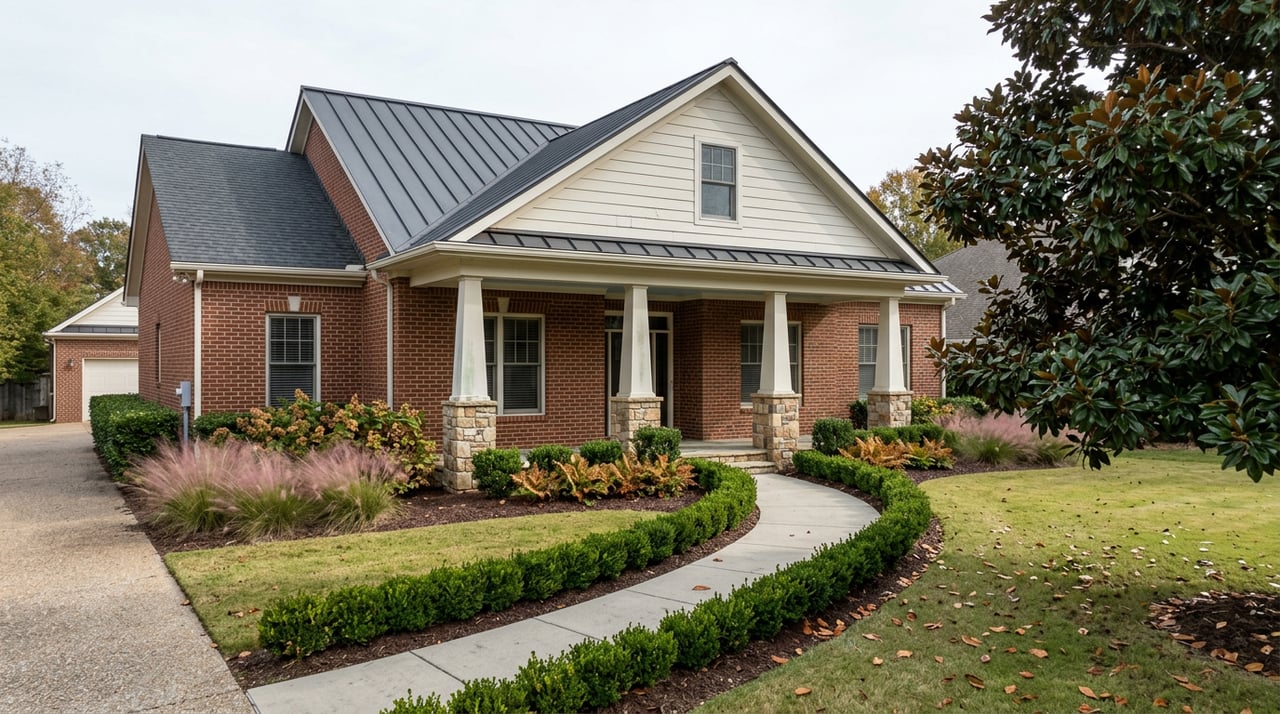
You're at the closing table on a home in Hamilton County this fall. The settlement statement shows a property tax credit from the seller, calculated the way it always is: take last year's tax bill, split it by the number of days each of you owned the home in 2026, and settle up. The number looks reasonable. You sign.
Then October comes, the actual bill lands in your mailbox, and it doesn't match what you prorated. Maybe it's lower. Maybe it's a few hundred dollars higher than anyone at the closing table expected. Either way, the gap traces back to something that happened before you ever toured the house: a countywide reappraisal that reset every property's assessed value as of January 1, 2025, and a rate-setting process that plays out differently depending on which side of a city line your home sits on.
The rate went down. That doesn't mean what you think.
Hamilton County completed its four-year countywide reappraisal in 2025, and the numbers were large. Countywide home values rose an average of around 60 percent since the last reappraisal in 2021, with commercial values up roughly 50 percent. Averaged together, that's about a 55 percent climb in overall property value, the biggest jump since local reappraisals began in 1989.
Tennessee law has a built-in response to that kind of spike. When assessed values rise countywide, the certified tax rate has to come down enough that total revenue stays flat, a mechanism spelled out in state law and administered through the Hamilton County Assessor's reappraisal process. County Assessor Marty Haynes and County Mayor Weston Wamp announced the new certified rate in June 2025: $1.51 per $100 of assessed value, down from $2.23, the lowest county rate since 1941.
That sounds like a straightforward win for homeowners. Haynes and Wamp framed it that way at the time:
"Following the four-year countywide reappraisal, we're proud to announce the lowest certified property tax rate Hamilton County has seen in more than 80 years. While property values have increased substantially over the last four years, most property owners, about two-thirds, will pay lower or about the same in county property taxes when compared to their 2024 property taxes."
Read that quote again and notice what it doesn't promise. Two-thirds pay less or the same. That leaves a third who pay more, and even among the two-thirds, "about the same" is doing real work. County commissioners were told directly that most homeowners would owe the county about as much as they did the year before, not meaningfully less. A lower rate on a much bigger assessed value doesn't automatically produce a smaller check.
Whether you come out ahead depends on your neighborhood, not the countywide average
The certified rate is built off a single number: the average increase across every parcel in the county. Your bill depends on how your specific property's increase compares to that average, not on the average itself.
If your home's assessed value rose by less than the countywide 60 percent, the lower rate more than offsets the increase and your bill drops. If it rose by more than that, the lower rate cushions the blow but doesn't erase it, and your bill goes up even though the rate on paper looks like a historic cut.
This is where geography matters more than usual this cycle. Local coverage of the reappraisal singled out North Shore, Ooltewah, Collegedale, East Brainerd, and downtown Chattanooga as areas where market values climbed the fastest. A buyer comparing a home in one of those submarkets to a home in a slower-appreciating part of the county isn't just comparing list prices. They're comparing two properties that are now on opposite sides of the countywide average, which means two different tax trajectories from the same certified rate.
The city line adds a second variable
Everything above describes the county's certified rate. Chattanooga, and every other municipality inside the county, goes through its own separate vote.
State law requires each governing body to accept the certified rate as a starting point, but it can choose to exceed it. History says that happens often. After the 2021 reappraisal, six of the county's ten municipalities raised their rates above the certified level. For 2026, Chattanooga's city council didn't simply adopt a revenue-neutral number. It passed a compromise budget rate of $1.93 per $100 of assessed value, confirmed on the city's own tax information page. That's down from the prior city rate, but combined with reassessed values, it's projected to raise many homeowners' bills by roughly $400 a year even with the lower nominal rate.
Here's what that looks like on paper for a home assessed at $300,000, using only the county and city rates and leaving aside school and special district levies that can also apply:
| Assessed value (25%) | Rate per $100 | Estimated annual tax | |
|---|---|---|---|
| Unincorporated county only | $75,000 | $1.51 | $1,132.50 |
| Inside Chattanooga city limits | $75,000 | $1.51 + $1.93 = $3.44 | $2,580.00 |
That's roughly $1,450 a year in difference on identical assessed values, purely from the choice of city limits versus unincorporated county. It's a real number worth running before you fall in love with a specific block, and worth confirming against your exact address through the Hamilton County Trustee's office since school and special district rates layer on top of both figures.
Where this catches buyers at the closing table
Tennessee bills property tax in arrears. The bill covering January through December of the current year isn't mailed until October, and it isn't due until the last day of February. That timing is exactly why property tax prorations at a mid-year Hamilton County closing are estimates, not facts. The closing attorney or title company typically works from the most recent bill they can find, which for a home selling this year still reflects the prior year's assessed value and rate in many cases, not the reappraised number that will actually generate the fall bill.
The later in the year you close, the bigger that estimate becomes, and the more room there is for the estimate to miss. A few things worth asking your closing agent to check before you sign:
- The property's current assessed value from the 2025 reappraisal, not just the last tax bill on file
- Whether the home sits inside Chattanooga's city limits or in unincorporated county, since that changes which rate applies
- Whether the proration credit was built with a cushion, given that the actual October bill may differ from the estimate
Tennessee changed one relevant rule as of July 2025: the buyer or borrower now has the exclusive, non-waivable right to choose the settlement agent, subject only to lender approval. That means you're not stuck with whoever the seller's side prefers. If the numbers on your settlement statement look thin, you have standing to ask for a second look before closing day.
What this means if you're comparing neighborhoods before 2029
The next countywide reappraisal isn't scheduled until 2029, according to the assessor's office. Whatever rate and assessed value combination applies to a home this year is the baseline for the next several years, not a one-time adjustment that smooths out quickly.
That makes this a good moment to run the actual math on any two homes you're weighing against each other, especially if one sits inside Chattanooga and the other doesn't, or if one is in a submarket that ran hot during the reappraisal window and the other didn't. A list price comparison alone won't show you that difference. The parcel record and the current certified rates will.
A few straight answers
Does the certified rate apply to school taxes too? The certified rate calculation applies to the general county and municipal rates. School funding and any special district assessments are set separately and can add to the totals shown above, so confirm the full combined rate for your specific address with the Trustee's office rather than relying on county and city rates alone.
If I already appealed my 2025 assessment, does any of this still apply to me? Yes. A successful appeal changes your assessed value, which changes your specific tax bill, but the certified rate mechanics and the arrears billing timeline described here apply to every parcel in the county regardless of whether the value was contested.
Will this same pattern show up again before the next reappraisal? Not in the same way. Barring a new reappraisal, assessed values stay fixed until 2029, so any future increase in your bill would come from a governing body voting to raise its rate again rather than a value adjustment, which is a different, and more visible, decision to track.
If you're weighing a purchase or a sale in Hamilton County and want the parcel-level numbers run before you're staring at a settlement statement, that's exactly the kind of groundwork Wesley Talley does before either side signs anything. Let's Connect.